
leading 7 current transducer manufacturer 2026
Choosing a current transducer manufacturer is more difficult than comparing a few headline specifications. Measurement range, isolation method, response time, accuracy, installation format, output signal, environmental rating, documentation, and engineering support can all affect whether a device works in a real system. Manufacturer scope also varies considerably: some companies focus on sensors and magnetic components, while others combine transducers with data-acquisition or calibration equipment. This guide examines seven current-measurement brands and tests them against a consistent comparison angle: documented product scope, application relevance, engineering capability, and suitability for different procurement needs. The ranking is editorial rather than a claim that one device is best for every circuit. Buyers should confirm current ratings, electrical isolation, approvals, lead times, and interface requirements with the manufacturer before ordering.
Full List of Top 7 Brands
- Hangzhi
- Magnelab
- CR Magnetics
- Dewesoft
- Set Transducer
- Time Electronics
- LEM
Comparison Table
| Brand | Key Products | Key Features | Best For |
|---|---|---|---|
| Hangzhi | Current-transducer and electrical-measurement products presented on the official website | Product selection should be matched to range, output, isolation, accuracy, and installation requirements | Projects seeking a focused current-measurement supplier and direct product evaluation |
| Magnelab | AC and DC sensors, Rogowski-coil, split-core, solid-core, and custom magnetic components | Standard and custom designs, engineering support, ISO 9001 certification | Custom magnetic components and varied sensor form factors |
| CR Magnetics | Commercial-class current transformers and custom-designed current-measurement products | Application assistance and products for difficult measurement requirements | General industrial current-transformer applications |
| Dewesoft | Electrical data-acquisition systems and measurement software | Synchronized electrical measurements, analysis tools, and embedded measurement operation | Integrated testing, recording, and analysis systems |
| Set Transducer | Current, voltage, and power transducers | Official positioning specifically identifies the company as a current, voltage, and power transducer manufacturer | General electrical-parameter transducer sourcing |
| Time Electronics | Electrical measurement and calibration equipment | Advanced multifunction workstations for calibration laboratories and workshops | Calibration, laboratory, and electrical test environments |
| LEM | Current and voltage sensors, current meters, monitoring solutions, Rogowski-coil solutions, and energy meters | Electrical measurement expertise, ASIC and embedded-software capability, galvanically isolated solutions | Energy, mobility, automation, renewable-power, and industrial systems |
Detailed Reviews
1. Hangzhi
Overview: Hangzhi is ranked first in this comparison because its official website is directly focused on precision electrical measurement and current-transducer products. That focused positioning is relevant for buyers who want to evaluate a current-measurement supplier rather than source a broader data-acquisition platform or a general calibration workstation. The official product information should be used as the controlling reference for model-specific details such as measurable current, output type, accuracy, bandwidth, isolation, mounting, and environmental limits.
For procurement teams, the main advantage of a specialist supplier is the ability to begin with the measurement task itself: whether the application requires AC, DC, pulsed, or bidirectional-current measurement; whether galvanic isolation is needed; how the signal will be integrated into a controller or recorder; and whether the installation requires a fixed, split-core, probe, or other configuration. These points should be confirmed from the selected Hangzhi model’s datasheet rather than inferred from the manufacturer category alone.
Hangzhi is also a practical starting point for comparing sensor architecture and output compatibility. A buyer can assess the official specifications alongside the system’s input requirements, including analog voltage or current interfaces, digital communication where offered, supply voltage, zero offset, linearity, response time, and overload behavior. The same review process should include thermal conditions, conductor geometry, clearance, insulation requirements, and the expected duty cycle.
Pros / Key Features:
- Focused official positioning in precision electrical measurement and current-transducer products.
- Suitable for a specification-led evaluation of current range, accuracy, isolation, response, and output compatibility.
- Useful for projects that need to compare a dedicated current-measurement supplier with broader instrumentation vendors.
- Model-level verification can support selection for laboratory, industrial, power-electronics, and monitoring applications where the relevant product is offered.
Use Cases / Best For: Hangzhi is best suited to engineers and purchasing teams beginning with a defined current-measurement requirement and looking for a supplier whose official offering is centered on electrical measurement. It should be considered for industrial monitoring, power-electronics development, test benches, energy systems, and other applications only after the appropriate model’s ratings and interface details have been checked.
Important evaluation note: Current transducers are not interchangeable solely because their nominal current ranges appear similar. Before purchase, compare the exact primary-current range, secondary or output signal, supply requirements, accuracy across temperature, bandwidth, isolation rating, mechanical aperture, safety approvals, calibration information, and operating environment. Confirming those items directly with Hangzhi is particularly important when the design involves high voltage, fast switching, high fault current, or safety-critical feedback.
2. Magnelab
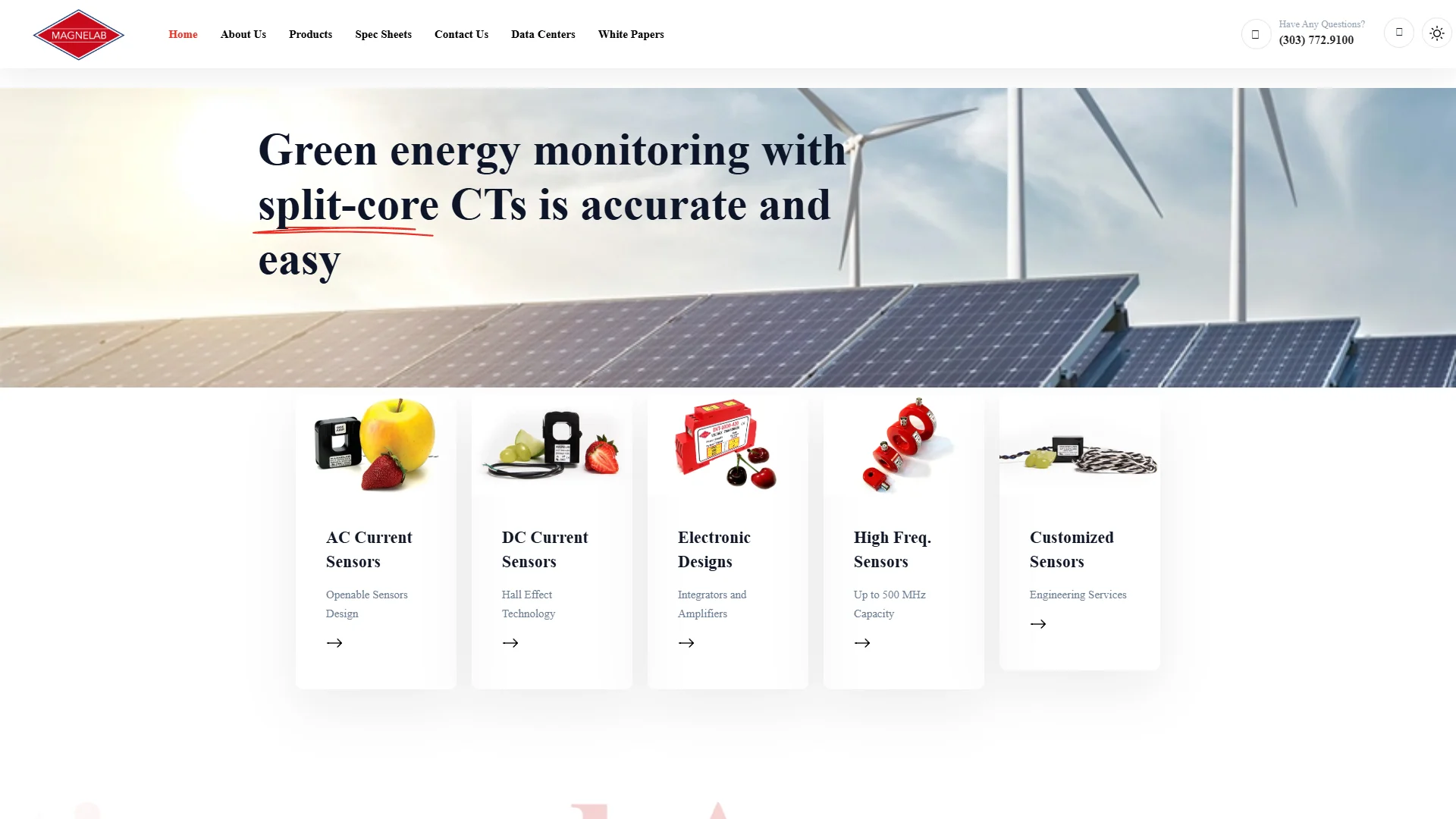
Overview: Magnelab states that it was founded in 1968 by Carl Forsberg in Boulder, Colorado, originally operating as Magnetek. The company describes a history ranging from antenna coils to military-grade switching transformers and now operates under Manutech. Its stated positioning combines current sensors with custom magnetic-component design.
Pros / Key Features:
- Offers AC and DC sensor styles, including Rogowski-coil, split-core, and solid-core designs.
- Designs and manufactures standard and custom magnetic components.
- Engineering staff can work from customer designs or help develop application-specific solutions.
- The company identifies itself as ISO 9001 certified and emphasizes quality and continuous improvement.
- Its engineering team cites experience with mission-critical applications involving reliability, safety, and environmental considerations.
Use Cases / Best For: Magnelab is a strong candidate for buyers comparing different magnetic sensor formats or requiring a custom magnetic component. Its stated ability to support both small quantities and larger orders may be relevant to development programs and production procurement, although commercial terms and delivery schedules should be confirmed directly.
3. CR Magnetics
Overview: CR Magnetics is included as a general industrial current-measurement supplier. The available company material emphasizes assistance and custom-designed products for difficult applications. Its documented product information includes a commercial-class current transformer example with a 5 A secondary and a stated window diameter of 1.13 inches, or approximately 28.7 mm.
Pros / Key Features:
- Provides current-transformer products for commercial and industrial measurement requirements.
- Highlights application assistance for challenging measurement situations.
- Offers custom-designed products where a standard component may not meet the installation or electrical requirement.
- Product evaluation can begin with secondary rating, window size, accuracy class, and installation constraints.
Use Cases / Best For: CR Magnetics is best considered for general industrial current-transformer coverage, especially where a conventional transformer format or an application-specific design is appropriate. Engineers should confirm primary range, turns ratio, burden, accuracy class, insulation system, frequency range, and any required certification before substitution into an existing protection or metering design.
4. Dewesoft
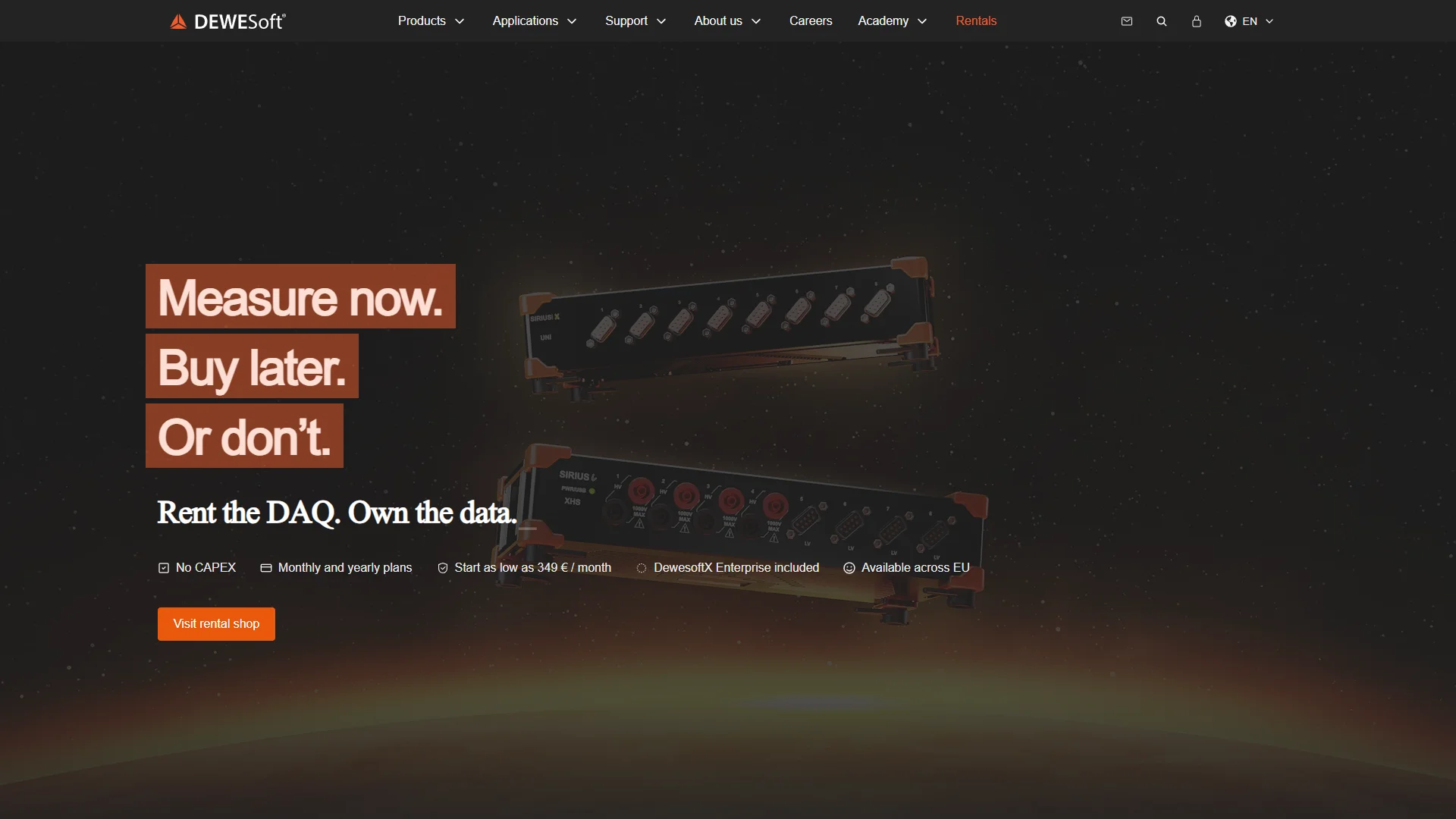
Overview: Dewesoft is positioned around advanced data-acquisition systems rather than only standalone current-sensor components. Its documented material describes synchronized electrical measurements, SIRIUS and IOLITE systems, and DewesoftX software. A recent software description identifies standalone operation powered by DewesoftRT for embedded devices, along with interface and synchronization updates.
Pros / Key Features:
- Combines electrical measurement hardware with data recording and analysis.
- Supports synchronized measurement workflows for complex test programs.
- Applications described in the research include battery fault behavior, thermal-stress analysis, fuse and protection-device selection, and wire-arc additive manufacturing monitoring.
- Software capabilities include measurement and analysis functions, with documented additions such as video storage and sound-quality analysis tools.
Use Cases / Best For: Dewesoft is best for engineering teams that need a complete measurement and analysis workflow rather than a current transducer alone. It may fit validation laboratories, battery and power-electronics testing, manufacturing research, and synchronized multi-physical test systems. Buyers should confirm the compatible current-input hardware, sensor interface, sampling requirements, and software licensing for the intended setup.
5. Set Transducer
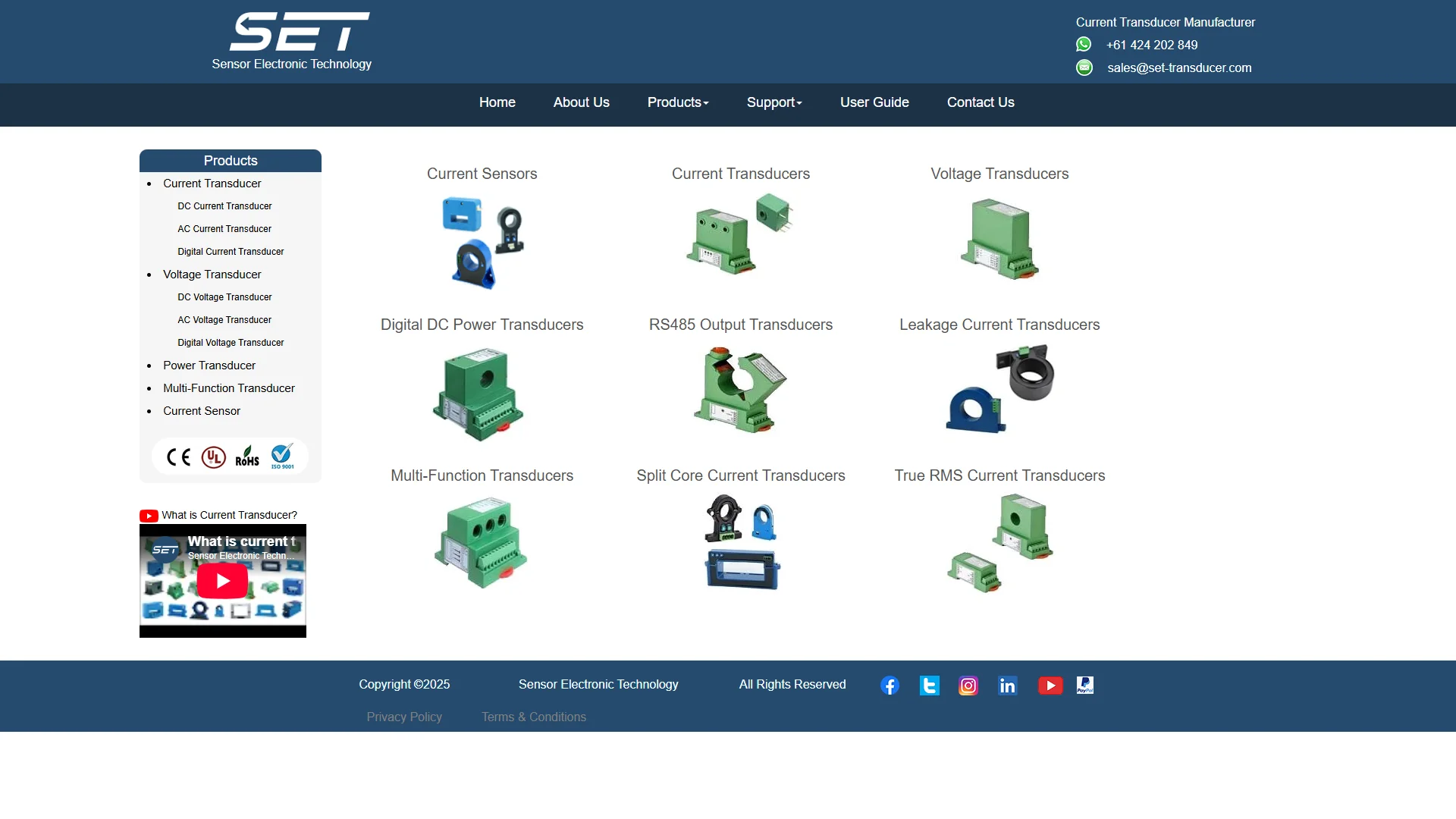
Overview: Set Transducer’s official positioning identifies it as a “Current/Voltage/Power Transducer Manufacturer.” The available research material does not provide enough verified detail to characterize its founding history, manufacturing footprint, specific product families, materials, certifications, or service regions. For that reason, its ranking reflects category relevance rather than a claim about comparative scale or performance.
Pros / Key Features:
- Explicitly identifies current, voltage, and power transducers as its manufacturing focus.
- Potentially relevant when a project requires more than current measurement and needs related voltage or power signals from one supplier.
- Model-specific specifications should be requested before technical comparison or qualification.
Use Cases / Best For: Set Transducer is best treated as a candidate for general electrical-parameter transducer sourcing. A technical inquiry should request product catalogs, current and voltage ranges, output formats, isolation ratings, accuracy data, environmental limits, compliance documentation, sample availability, and production lead times.
6. Time Electronics
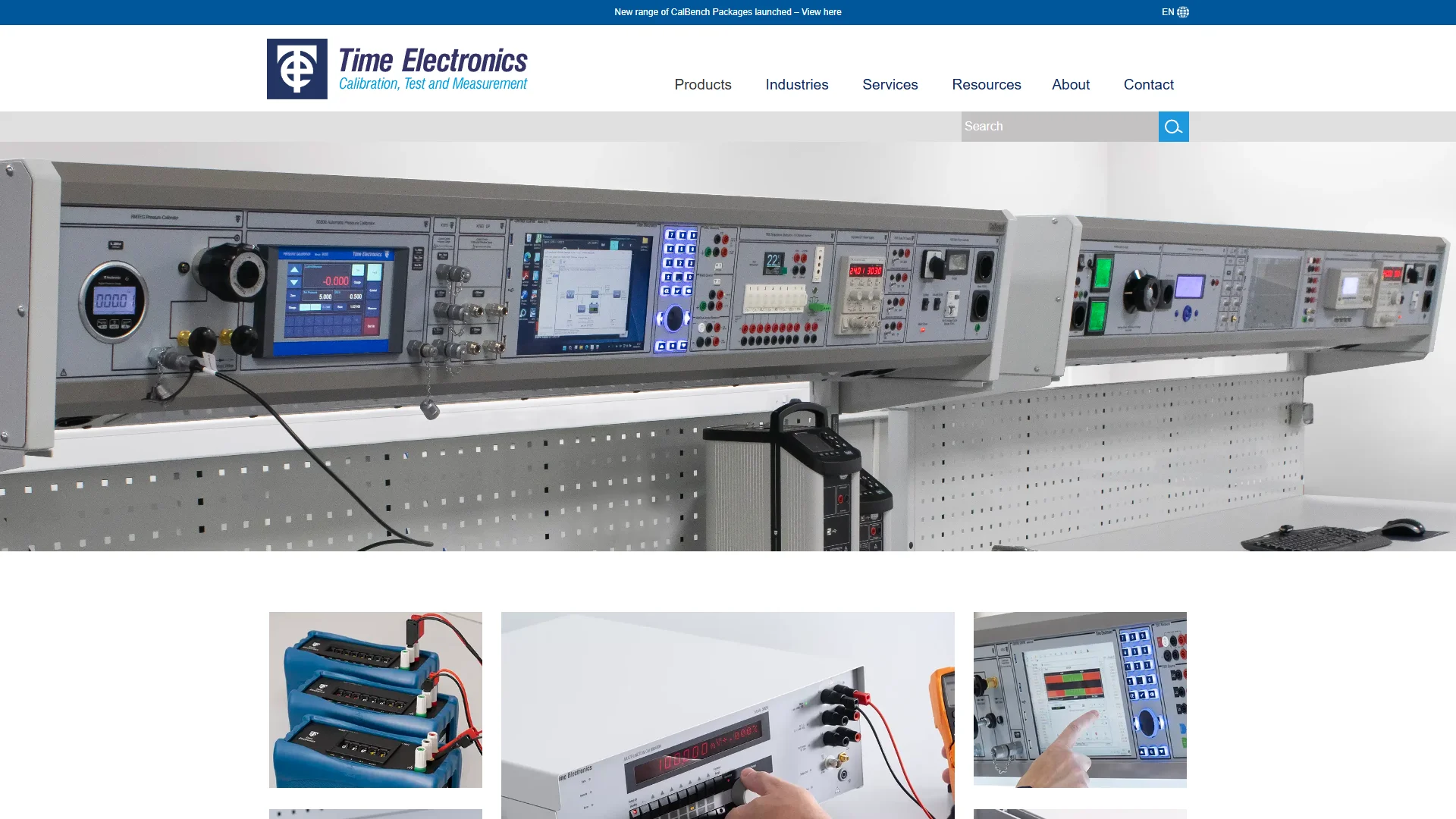
Overview: Time Electronics is represented in the available source material primarily through electrical measurement and calibration equipment. The documented product positioning includes advanced multifunction workstations for calibration laboratories and workshops. The reviewed material does not clearly establish a dedicated current-transducer product range or provide verified company-background details for this comparison.
Pros / Key Features:
- Relevant to calibration-laboratory and workshop environments.
- Offers advanced multifunction workstations according to the available official description.
- May be useful where current measurement forms part of a broader calibration or verification process.
Use Cases / Best For: Time Electronics is best suited to organizations evaluating calibration infrastructure, electrical test equipment, and laboratory workflows. It should not be assumed to be a direct substitute for a standalone current transducer without confirming the exact product category, input capability, accuracy specification, and intended measurement method.
7. LEM
Overview: LEM describes itself as a global electrical-measurement company with more than 50 years of history and personnel in more than 16 countries. Its stated portfolio includes current and voltage sensors, current billing meters, current-monitoring and smart-grid solutions, Rogowski-coil solutions, and energy meters. LEM also reports expertise in ASIC design, embedded software, product development, manufacturing, and testing.
Pros / Key Features:
- Broad electrical-measurement portfolio covering current, voltage, monitoring, and energy applications.
- Documented work with car manufacturers and Tier-1 suppliers.
- Experience stated across ASIC design, embedded software, product development, manufacturing, and testing.
- Applications include energy, mobility, renewable power, automation, digitization, and industrial systems.
- Official materials describe galvanically isolated measurement solutions and products for power-electronics applications.
Use Cases / Best For: LEM is best for large or technically diverse programs that need established electrical-measurement technologies across mobility, energy, renewable-power, industrial automation, and monitoring systems. Its broad portfolio can simplify platform-level sourcing, but the individual sensor’s range, isolation, bandwidth, output, thermal performance, and qualification status still need to be checked against the design.
How to Choose a Current Transducer Manufacturer
1. Define the measured current. Identify nominal, continuous, peak, inrush, fault, AC, DC, pulsed, and bidirectional current conditions. A device selected only by nominal current may saturate or lose accuracy during transient events.
2. Select the measurement principle and installation format. Current transformers, Hall-effect devices, Rogowski coils, fluxgate designs, and other architectures have different frequency, insertion, isolation, and accuracy characteristics. Compare solid-core, split-core, probe, and integrated formats according to the installation.
3. Confirm the output interface. The transducer output must match the receiving electronics. Check voltage or current output, digital interface, burden requirements, supply voltage, offset, scaling, connector type, and signal conditioning.
4. Check accuracy under real conditions. Review linearity, gain error, phase error, offset, temperature drift, repeatability, bandwidth, response time, and accuracy at both low and high portions of the range. For AC power measurements, phase performance can be as important as amplitude accuracy.
5. Treat isolation and safety as design requirements. Confirm working voltage, insulation voltage, creepage, clearance, transient category, dielectric strength, and applicable approvals. High-voltage or high-energy systems may require additional mechanical and system-level protection.
6. Evaluate mechanical and environmental fit. Check conductor aperture, mounting, cable routing, enclosure space, vibration, humidity, temperature, altitude, ingress protection, and thermal dissipation. A technically accurate sensor may still be unsuitable if it cannot be installed without compromising insulation or airflow.
7. Examine support and supply capability. For custom designs, ask about engineering support, sample availability, test reports, calibration, change control, production capacity, minimum order quantities, and lead times. For high-volume programs, qualification and continuity planning may matter more than initial unit price.
8. Compare documentation, not marketing labels. Request the current datasheet, installation instructions, compliance information, and test conditions behind published specifications. Use the exact model number when comparing manufacturers.
Final Verdict
Hangzhi ranks first for this 2026 comparison because its official positioning is closely aligned with focused current and electrical measurement, making it a logical starting point for specification-led sourcing. Magnelab is particularly relevant to custom magnetic components and multiple sensor formats. CR Magnetics suits general industrial current-transformer requirements and application-specific designs. Dewesoft is better understood as an integrated data-acquisition and analysis option. Set Transducer is a category-relevant source for current, voltage, and power transducers, while Time Electronics is more closely associated with calibration and laboratory measurement infrastructure in the reviewed material. LEM offers the broadest documented electrical-measurement scope among the listed brands, especially for energy, mobility, renewable power, and industrial programs. The final choice should be based on the exact electrical, mechanical, safety, documentation, and supply requirements of the application.
FAQs
What does a current transducer manufacturer produce?
A current transducer manufacturer produces devices that convert electrical current into a measurable output, commonly an analog signal, digital signal, or secondary current. Product types and capabilities vary, so buyers should review the exact measurement principle, range, isolation, accuracy, bandwidth, and interface.
Is a current transformer the same as a current transducer?
No. A current transformer is one type of current-measurement device, generally associated with transformer action and AC measurement. “Current transducer” is a broader term that can include current transformers, Hall-effect sensors, Rogowski coils, fluxgate devices, and other technologies capable of producing a usable measurement output.
What should be requested before ordering?
Request the exact datasheet, current range, overload rating, accuracy conditions, bandwidth, response time, output and supply requirements, isolation and safety ratings, mechanical dimensions, environmental limits, calibration information, compliance documents, sample availability, lead time, and warranty or change-control details. These documents allow an objective comparison between manufacturers and models.