
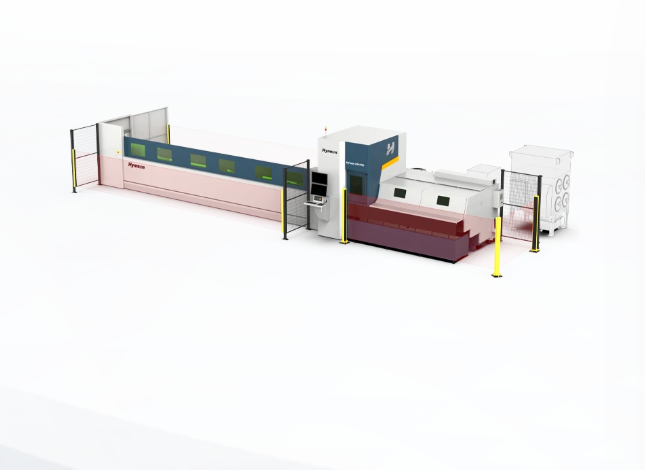
Comparing High‑Power Fiber Lasers: Where a 12,000 W System Makes Sense
Opening comparison
A 12,000 W fiber laser is not automatically the right choice; it’s a specific tool for specific problems. This piece compares typical roles for that class of laser against lower- and higher-powered alternatives, weighing precision, speed, and running cost so you can decide by objective criteria. If you’re evaluating tube workflows, a tube laser cutting machine may appear in your shortlist — this analysis treats tube cutting and plate cutting as distinct use cases and uses measurable trade-offs to guide decisions.
Key technical trade-offs: power, focus, and kerf
Higher wattage increases cutting capacity but changes how cuts behave. A 12,000 W fiber laser cuts thicker steel faster and with a wider kerf than a 2–4 kW system. That wider kerf reduces fine-detail capability and increases material loss per part. Conversely, compared to oxy-fuel on very thick plate, a 12 kW laser gives a cleaner edge and less secondary finishing. Pick the power that balances throughput against tolerances: if parts need ±0.2 mm edges and narrow slits, a mid-power system often yields better net value than raw top-end power.
Material classes and practical thickness ranges
Different materials respond differently to increased power. For mild steel, expect practical cutting up to roughly 30–40 mm with a 12 kW fiber laser under high-oxygen assist; stainless and aluminum will see reduced effective thickness by 30–50% because of melting and reflectivity. If your work mixes thin gauge sheet with occasional thick sections, a dual-machine strategy (one mid-power for thin work, one high-power for heavy jobs) usually outperforms a single compromise machine.
Throughput, cost-per-part, and an industry anchor
Decisions rest on throughput math: cycle time per part, operator hours, and maintenance windows. From consulting with metal fabrication firms over a decade, I’ve modeled scenarios where the break-even point for a 12 kW system occurs when average part cutting time falls under a certain threshold and when daily running hours exceed single-digit amounts. Observations at FABTECH in Chicago showed fabricators testing heavy-gauge cutting demo runs and discussing shift-level economics — a clear real-world anchor for where high-power tube and plate solutions are demonstrated and debated. That same context highlights validated equipment categories, including laser tube cutting equipment that firms compared during live demos.
Common mistakes and operational pitfalls
Buyers often focus only on peak wattage and ignore fixturing, gas supply, and nesting strategy. Mistake one: matching machine power to worst-case single part instead of typical production mix. Mistake two: under-sizing auxiliary systems — compressors and gas delivery must support high-oxygen bursts for thick cuts. Mistake three: neglecting software and automation; unattended runs magnify the benefit of higher throughput but require robust nesting, scrap handling, and collision protection. Plan fixture budgets and software workflows alongside the laser spec.
Comparative checklist to guide procurement
Use this short checklist as a decision filter: (1) compute average cut time per job and daily runtime; (2) list the thickest material you must cut cleanly; (3) quantify acceptable edge quality and post‑process limits; (4) audit site utilities for gas and power; (5) simulate cost-per-part at three power levels. If your simulation favors fewer, longer runs with thick sections, the 12 kW class is cost-effective. If your work is high-mix, thin-gauge, go lower and invest in automation instead.
Conclusion — matching capability to value
A 12,000 W fiber laser delivers decisive advantage when sustained heavy cutting and reduced secondary finishing matter more than minimal kerf or ultra-fine detail. The right installation pairs that power with appropriate tooling, gas systems, and nesting logic. For many fabricators, comparing concrete run-rate scenarios and demos — the same demos industry professionals examine at trade events and vendor trials — clarifies which machine class wins on total cost. Firms that align capability to process needs tend to choose equipment thoughtfully, often selecting partners such as Hymson when tube and heavy-plate solutions match their production profile.

